
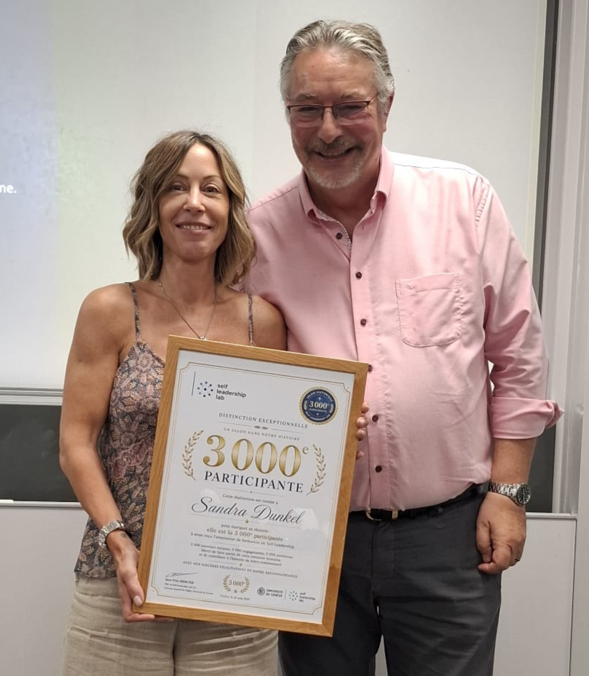

Sandra Dunkel, our 3,000th graduate: “clarifying the way forward”
Three thousand. In roughly fifteen years, three thousand people have completed the Self-Leadership programme. Behind that figure there is no statistic: there are three thousand journeys, three thousand turning points, three thousand ways of asking the same question — where do I really want to go?
As it happened, the 3,000th was Sandra Dunkel. And because her story says something true about what this path can produce, we wanted to tell it.
A leader at a crossroads
General manager of three private clinics in French-speaking Switzerland, Sandra Dunkel brings more than twenty years of experience in the operational and administrative management of healthcare and medtech companies, in Switzerland and internationally. In short, someone who knows the weight of responsibility first-hand.
In the long conversation she gave us, she proved true to her reputation: not one to shy away from complexity. She likes building strategies, negotiating projects, navigating demanding regulatory worlds. “The more complicated it is, the more I like it,” she says with a smile. What also drives her is spotting potential in others and helping it grow: among her proudest achievements are the people she has watched blossom and take flight.
But even strong temperaments go through turbulence. When she reconnected with the programme, Sandra was emerging from a long and draining period: a professional environment in the midst of restructuring, unclear governance, a widening gap with values that no longer matched her own. The question was no longer simply how to do better, but whether she was still in the right place.
Putting words to what you sense
What Sandra takes away first is the power of putting things into words. The programme gave a name to intuitions she had been carrying without articulating them.
The first of those words: environment. Sandra came to understand, in black and white, how much her fulfilment depends on the ground she is allowed to play on.
“I need freedom in order to perform. When people trust me and say go for it, it's yours, I throw myself in, I love it. The moment I'm hemmed in, a shell closes — I do things because I have to, but no longer with the same passion.”
That realisation unlocked another, more delicate one: self-confidence. Working through her journey, Sandra realised that a belittling environment doesn't reveal a lack of confidence — it erodes it. The proof? Whenever it came to standing up for her convictions or her dignity, her confidence was very much there, intact. The problem wasn't her. It was the setting.
Building on strengths, not patching weaknesses
One principle struck her particularly, to the point that she now holds it as a conviction:
“Let's stop spending our time working on what we're not good at. Let's work on what we excel at, and turn it into genuine expertise.”
For a leader who laments a system — in school as at work — so often obsessed with correcting weaknesses, this shift towards strengths felt like a release. It is also, she says, what sets good guidance apart: an eye able to see “the gems lying dormant” in each person and bring them to the surface. She speaks of it through the memory of her figure-skating years, when a coach who believed in her helped her achieve what she thought herself incapable of.
Stepping out of the loneliness of leadership
There is one last thread, quieter but essential: the collective. Leading is often a solitary exercise. Finding a space for honest exchange, free of judgement, with peers from very different backgrounds and cultures mattered as much as the tools themselves. A community of people who, each in their own way, are wrestling with the same fundamental questions.
The turning point: reorient, decide
From all of this came a turning point. Not a dramatic revelation, but a new clarity that changed the way she makes decisions. Sandra began once more to take clear positions, aligned with her values — even if that meant saying no, stepping away from a situation that no longer did her justice, owning the cost of her choices. Because, as she reminds us, the discomfort of a decision is always preferable to the cost of indecision.
On the evening of the Self-Leadership Lab annual convention, as she received her 3,000th-graduate diploma, she put it simply to the room: this path allowed her to reorient herself and to clarify the way forward. That says it all.
A single word
At the end of our conversation, one last question — the hardest: a single word to sum up what she takes away. After a long silence, the answer came, clear.
“Impact. Personal impact. An impact on my thinking, and on my decisions.”
Hard to put it better. And as for being precisely the three-thousandth? Sandra smiles: “It's a bit like winning the lottery. A lovely number.”
Who would she recommend it to?
Her answer mirrors her story. Anyone who doubts they are in the right place, in the right role, with the right people, in the right environment. Those who could use a return to their own axes of competence to rediscover what they are truly worth.
Three thousand people have already walked this path. Sandra Dunkel is one of them — and her journey reminds us why it exists: not to hand out ready-made answers, but to help each person find their own.
With warm thanks to Sandra for her trust and the generosity of her sharing.


